Consulting · GEO / AEO · B2B SaaS 20–200 people
AI visibility consultant for B2B SaaS companies in the US and UK
An AI visibility consultant measures how often AI assistants mention and cite your company when buyers ask about your category, then closes the gaps that keep you out.
You get one number you can defend in a board meeting, a ranked list of what to fix, and a written answer when the data says nothing has changed.
I work alone, with four to six clients at a time, on the part of the funnel that now happens before anyone reaches your site: the moment an assistant assembles a shortlist and either names you or does not. No agency layer, no account manager, no reselling of someone else's dashboard.
2 studies
published with raw runs, sample sizes and dates attached
4,200
prompts measured across engines to date
Open
protocol and reference prompt set published on /method/
14+ yrs
product, web and technical SEO — I implement, not just advise
What is AI search visibility?
AI search visibility is the share of AI-generated answers in your category that name your company, and the smaller share that link to it. Those are two different outcomes and they behave differently: a mention shapes the shortlist, a citation sends a visitor. Reporting them as one blended figure is the most common way this work gets misrepresented, so I keep them on separate lines from the first measurement onward.
The work goes by several names — generative engine optimization, answer engine optimization, GEO, AEO. They describe the same practice, and which term you hear depends mostly on who is selling. I use GEO and AEO interchangeably, avoid the newer acronyms nobody searches for, and describe the actual work in plain language wherever a decision depends on it.
Why does it matter now?
Because the shortlist is now assembled before your site is ever opened. A buyer describes a problem, an assistant names three or four vendors, and the evaluation starts from that list. If you are not on it, you are not losing a deal on price or product — you are not in the room where the comparison happens.
Who is this for?
B2B SaaS companies of roughly 20 to 200 people selling into the US or UK, with a category that buyers actually ask assistants about. If your category shows almost no assistant-driven demand, I will say so and tell you to spend the money on demand generation instead.
Isn't GEO just SEO with a new name?
Partly, and I would rather say it now than have you discover it in month three. The technical hygiene overlaps almost entirely: crawlability, clean HTML, sensible information architecture, fast pages, correct structured data. If a consultant tells you AI visibility is an entirely new discipline, they are selling you a label. Four things, however, are genuinely different, and they are different enough to change what you measure and where you spend.
| Dimension | Classic SEO | GEO / AEO |
|---|---|---|
| Unit of result | A ranking position for a keyword | A mention, and separately a citation, inside a generated answer |
| Stability | Ranks are broadly reproducible day to day | Same prompt, same day, different list — under a 1 in 100 chance of an exact repeat |
| Where the win happens | Mostly on pages you own | Mostly on cited third-party pages: comparisons, review sites, roundups |
| Crawler layer | Googlebot renders JavaScript | No major AI crawler executes JS. Separate bots, separate permissions, silent failures at the WAF |
| Analytics | Referrers mostly survive | A third to two thirds of AI traffic lands in GA4 as Direct |
| Honest reporting | Point estimates are acceptable | Only intervals are meaningful; month-over-month deltas often are not interpretable |
What does the problem look like in numbers?
Every figure here is measured, sourced and dated, and every one of them is a reason a single manual check in ChatGPT tells you almost nothing. You will notice none of them is a growth percentage: I do not have a defensible way to promise one, and neither does anyone quoting you +3,000%.
How does the engagement actually run?
Click a step to open it
Four steps, in this order, every time. Freeze the measurement before you touch anything, clear the access problems that make you invisible to crawlers, place your evidence where engines actually read it, then prove — or disprove — the change with the same frozen set. The order matters more than the labels: work done before the baseline exists cannot be evaluated afterwards.
What I do
Build and lock a prompt set of 50–200 buyer-intent questions segmented by buying stage, then run it three or more times across four engines before anything on your side is touched.
Check what the AI crawlers can actually reach: robots directives per bot, WAF and bot-management rules, JS dependency of key content, server-rendered availability of docs and pricing.
Work on where the citations actually come from: the third-party comparisons and roundups engines read, plus answer-shaped pages of your own that can be quoted in a sentence.
Re-run the frozen set on schedule and compare against the baseline under the rule agreed up front: overlapping intervals mean no trend, and I say so.
What you get
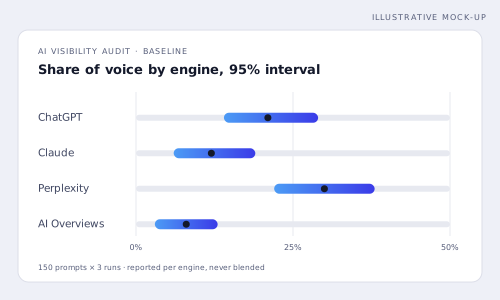
A baseline you can return to: share of voice and citation rate per engine with 95% intervals, a competitor benchmark, and the prompt set itself as a file you own.
A list of access failures ranked by what they cost you, with the exact rules to change and a spec your engineers can implement without me.
A prioritised content and placement backlog, drafts or specs for the pages that matter, and a written note of what I would not bother doing.
A short report per cycle with per-engine intervals, what moved beyond noise, what did not, and a recommendation to continue, change or stop.
What's included, and what does it cost?
Prices are published here as well as on the pricing page, because a figure that ends the conversation saves us both a call. Retainers start at three months for a measurement reason, not a commercial one: with 40–60% monthly rotation in the domains engines cite, a one-month delta cannot be interpreted at all. Anything shorter would be me charging you to read noise.
AI Visibility Audit
$1,500
10 working days
150–200 prompts × 3 runs, 4+ engines, competitor benchmark, crawler access check, cited-source inventory, prioritised backlog
Monitoring
$750 / mo
weekly runs
Frozen set of 50–100 prompts, weekly runs, per-engine interval reporting, alerts only when a move clears the interval
Full GEO retainer
from $3,000 / mo
3 months minimum
Monitoring plus technical clean-up, work on cited third-party sources, and content built to be quoted — implemented, not just specified
Advisory call
$250 / hour
one-off
Review someone else's proposal, sanity-check a plan, or answer your team's questions with no engagement attached
How I measure
Why do you report intervals instead of a single number?
Because a single number implies a precision the medium does not have. Ask the same question twice and the list comes back different; across 2,961 repeat runs in an independent study, the chance of an identical list twice was under 1 in 100, and identical order under 1 in 1,000. A point estimate hides that entirely. An interval shows it, which is less flattering and considerably more useful when you are deciding where to spend.
So the protocol is deliberately boring. A frozen set of 50 to 200 buyer-intent prompts, segmented by buying stage. Three or more runs per prompt. Four or more engines, reported separately and never blended, because only about 11% of cited domains overlap between ChatGPT and Perplexity. Mentions and citations counted separately. And one rule agreed in writing before we start: if the intervals overlap, there is no trend, and I will tell you so in the same report you are paying for.
- Prompts
- 50–200, frozen, by buying stage
- Runs
- 3+ per prompt, same day
- Engines
- ChatGPT, Claude, Perplexity, AI Overviews
- Reported
- Per engine, 95% intervals
- Published
- Protocol and prompt set
What will I not sell you?
Three things appear in almost every GEO proposal and none of them survives contact with data. I am listing them because you will be quoted for them, probably this quarter, and because the fastest way to judge any consultant — including me — is to ask which of their deliverables has evidence behind it and which is just plausible.
Not sold here
llms.txt as a citation booster
Google has confirmed publicly that no system of theirs consumes it, and a study across 300,000 domains found no relationship to citation rates. This site deliberately has none, with a page explaining why.
Not sold here
FAQ schema as an AI lever
Measured across 129,000 domains, pages carrying FAQ markup averaged 3.6 citations against 4.2 without it. The questions matter; the markup does not. Schema is entity hygiene, not a multiplier.
Not sold here
Guaranteed inclusion in AI answers
Repeat the same prompt and the list changes, so a guaranteed position in ChatGPT is a promise about a number nobody controls — including me. I contract on process and leading indicators instead.
Questions buyers ask me before signing
Answered in full sentences, first sentence first, so you can read the answer without opening a call.
An AI visibility consultant measures how often AI assistants name and cite your company in your category, diagnoses why the gaps exist, and closes the ones that are closable. In practice that is measurement first, crawler and access work second, and work on the cited third-party sources third.
In practice yes — GEO, AEO and answer engine optimization describe the same work under different labels, and the term you hear depends on who is selling. I use GEO and AEO interchangeably and avoid the newer acronyms nobody searches for.
It overlaps with them more than either of us would like to admit, which is why I would rather your existing agency keep the hygiene work. What I add is measurement that survives scrutiny, per-bot crawler access, and deliberate work on the third-party pages engines cite instead of yours.
With a frozen set of 50 to 200 buyer-intent prompts, run three or more times across four or more engines, reported per engine as share of voice and citation rate with 95% confidence intervals. The full protocol and a reference prompt set are published on the method page.
An AI visibility audit is $1,500. Monitoring is $750 a month. A full GEO retainer starts at $3,000 a month with a three-month minimum, and advisory calls are $250 an hour. All of it is published on the pricing page.
For a new or low-authority domain, plan on four to six months before movement clears the interval. Median time to first citation for fresh material is around a week, but that assumes you already hold authority somewhere engines read.
ChatGPT, Claude, Perplexity and Google AI Overviews as standard, always reported separately. Only about 11% of cited domains overlap between ChatGPT and Perplexity, so a blended number hides more than it reveals.
Then the report says so, with the interval that proves it, and we decide whether to change approach or stop. The engagement is contracted on process and leading indicators rather than promised outcomes, because reliable revenue attribution for AI answers does not exist yet.
No, and neither can anyone else. Repeat runs of an identical prompt return different lists, so a guaranteed position is a promise about a number no consultant controls.
Sometimes that is the right answer and I will give it to you. If your category shows almost no assistant-driven demand yet, spend the budget on demand generation and come back in two quarters — the audit will cost the same and tell you more.
Send me your domain and three competitors.
I will tell you whether there is an AI visibility gap worth paying to fix before you pay for anything. If the honest read is “wait two quarters”, you get that in writing instead of an invoice — the audit will cost the same later and tell you more.